In today’s fast moving digital world, businesses don’t just compete on products they compete on speed, reliability, and innovation. The ability to release features quickly, fix issues instantly, and scale seamlessly has become the ultimate competitive advantage to learn DevOps Fundamentals.
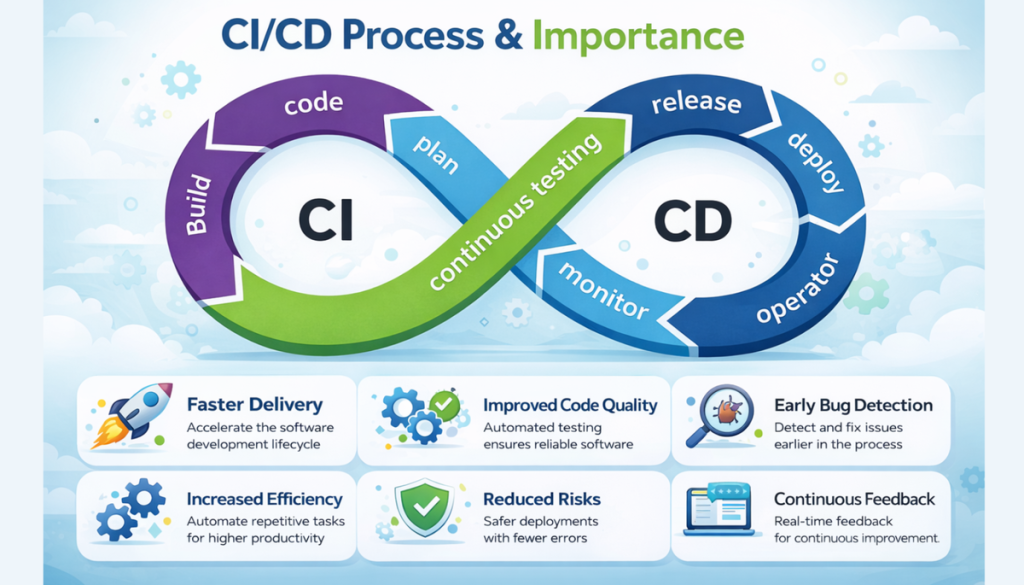
This is where DevOps changes everything.
If you’re looking to understand DevOps deeply — not just as a buzzword, but as a career path and engineering philosophy — this comprehensive guide will give you everything you need.
What Is DevOps?
DevOps is a combination of development (Dev) and operations (Ops) that focuses on collaboration, automation, and continuous delivery of software.
Traditionally, development teams built applications while operations teams deployed and maintained them. However, this separation often created delays, misunderstandings, and deployment failures.
DevOps removes these silos.
Instead of working in isolation, developers, operations engineers, QA teams, and security professionals collaborate throughout the entire software lifecycle — from planning to production monitoring.
In simple terms:
DevOps is a culture and practice that enables faster, more reliable software delivery through automation and collaboration.
Why DevOps Is Important in 2026 and Beyond
Modern companies release software multiple times per day. Without DevOps practices, that level of agility is nearly impossible.
Here’s why DevOps matters:
Faster Time to Market
Organizations can deliver features quickly and respond to customer feedback in real-time.
Improved Software Quality
Automated testing ensures bugs are caught early before reaching production.
Better Collaboration
Developers and operations teams share responsibility, reducing blame culture.
Higher Deployment Frequency
Instead of quarterly releases, teams can deploy daily or even hourly.
Improved System Stability
Continuous monitoring ensures rapid detection and resolution of issues.
Businesses that adopt DevOps outperform competitors in innovation speed and operational efficiency.
The Core Principles of DevOps
To truly understand DevOps, you must understand its foundational principles.
Continuous Integration (CI)
Developers frequently merge code changes into a shared repository. Each integration triggers automated builds and tests.
Benefits:
- Detect bugs early
- Avoid integration conflicts
- Maintain stable codebase
Continuous Delivery (CD)
Code changes are automatically prepared for production deployment.
This ensures:
- Faster releases
- Reliable deployment processes
- Reduced manual intervention
Automation
Automation is the backbone of DevOps.
Tasks like:
- Code building
- Testing
- Infrastructure provisioning
- Deployment
- Monitoring
are automated to reduce human error and improve speed.
📊 Continuous Monitoring
Monitoring systems track application performance, infrastructure health, and user behavior.
This allows teams to:
- Detect issues instantly
- Improve system reliability
- Optimize performance
Continuous Feedback
Feedback loops help teams continuously improve. Data from monitoring tools and customer input drives better decisions.
DevOps is not a one-time setup — it’s an ongoing improvement cycle.
DevOps Lifecycle Explained
The DevOps lifecycle includes several continuous phases:
- Planning – Define features and requirements
- Development – Write and manage code
- Build – Compile and package application
- Testing – Automated and manual testing
- Release – Prepare for deployment
- Deploy – Push to production environment
- Operate – Maintain and manage infrastructure
- Monitor – Track performance and collect insights
This loop continues endlessly, enabling rapid iteration and improvement.
Popular DevOps Tools You Should Know
While DevOps is about culture, tools play a critical role.
Version Control
- Git
- GitHub
- GitLab
CI/CD Tools
- Jenkins
- GitHub Actions
- GitLab CI
Containerization
- Docker
Orchestration
- Kubernetes
Configuration Management
- Ansible
- Terraform
Monitoring
- Prometheus
- Grafana
Learning these tools makes you job-ready in the DevOps ecosystem.
DevOps vs Traditional IT Model
| Traditional IT | DevOps |
|---|---|
| Separate teams | Collaborative teams |
| Manual deployments | Automated deployments |
| Slow releases | Frequent releases |
| High failure rate | Improved reliability |
| Reactive problem-solving | Proactive monitoring |
The difference is not just technical — it’s cultural.
DevOps Culture: The Real Game Changer
Many beginners think DevOps is about tools. It’s not.
DevOps is about:
Shared ownership
Transparency
Automation mindset
Continuous learning
Fast feedback
Organizations fail at DevOps when they adopt tools but ignore cultural change.
True DevOps transformation requires leadership support, mindset shift, and team empowerment.
How to Start Learning DevOps
If you are a beginner, follow this roadmap:
Learn Basics
- Linux fundamentals
- Networking basics
- Git version control
Understand Software Development Lifecycle (SDLC)
Learn CI/CD Concepts
Practice with Cloud Platforms
- AWS
- Azure
- Google Cloud
Step 5: Build Real Projects
- Create CI/CD pipelines
- Deploy applications
- Implement monitoring
Practical experience matters more than theory.
DevOps Career Opportunities
DevOps professionals are among the highest-paid engineers globally.
Popular roles include:
- DevOps Engineer
- Site Reliability Engineer (SRE)
- Cloud Engineer
- Platform Engineer
- Automation Engineer
Skills in automation, cloud computing, and CI/CD pipelines are highly demanded in 2026.
Common Myths About DevOps
DevOps is just a tool
DevOps eliminates operations jobs
it is only for startups
it is easy
Reality:
DevOps requires continuous learning, collaboration, and discipline.
Real-World Benefits of DevOps
Companies using DevOps report:
- 2x faster deployment cycles
- Reduced downtime
- Improved customer satisfaction
- Faster innovation
- Lower operational costs
DevOps transforms businesses into agile, technology-driven organizations.
The Future of DevOps
The future includes:
- DevSecOps (Security integrated into DevOps)
- AI-driven automation
- Platform engineering
- GitOps workflows
- Cloud-native architectures
DevOps is evolving — and professionals who adapt will thrive.
Final Thoughts
DevOps is not just a technical framework. It’s a mindset that enables organizations to innovate faster, deliver better software, and stay competitive in a digital-first world.
If you want a successful career in technology, mastering DevOps fundamentals is one of the smartest decisions you can make.
Start small.
Practice consistently.
Automate everything possible.
Embrace collaboration.
The future belongs to those who build, deploy, and improve continuously.
Next Steps :
Follow our DevOps tutorials
Explore more DevOps engineer career guides
Subscribe to InsightClouds for weekly updates
Devops tutorial :https://www.youtube.com/embed/6pdCcXEh-kw?si=c-aaCzvTeD2mH3Gv
Leave a Reply