In a world where industries evolve every quarter and AI reshapes job roles overnight the biggest risk is not failure.
It’s stagnation.
Careers don’t collapse suddenly. They slowly decay when skills stop compounding. Meanwhile, the market keeps moving. Salaries rise for those who adapt. Opportunities expand for those who position themselves strategically.
The good news?
You don’t need five years.
And You don’t need an MBA.
You don’t need a miracle.
You need 12 focused months.
This is not motivational fluff.
This is a practical, real-world 12-month career upgrade plan designed to increase your market value, earning potential, and professional confidence.
If executed with discipline, this framework can transform your trajectory permanently.
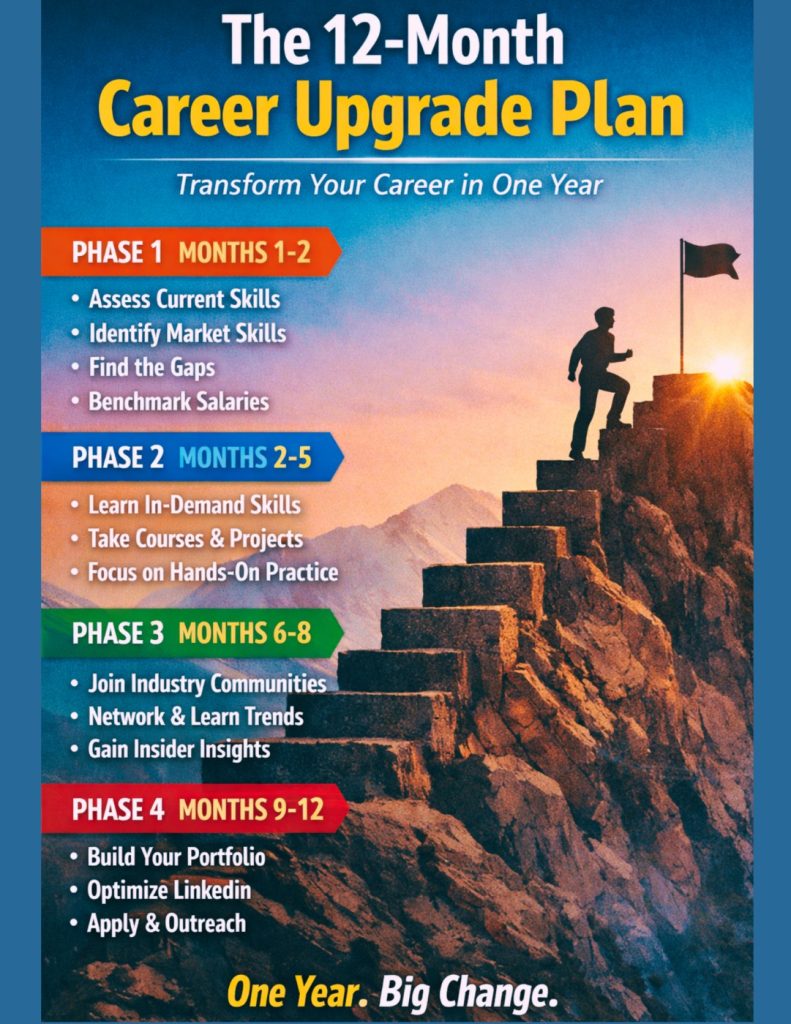
Phase 1 (Months 1–2): Strategic Self-Audit and Market Alignment
Before you chase certifications or courses, you need clarity.
Most professionals make a critical mistake: they try to “learn more” without understanding what the market actually rewards. Effort without direction wastes time.
Instead, begin with a structured self-audit.
Step 1: List Your Current Skills
Document everything:
- Technical skills
- Soft skills
- Tools you know
- Projects you’ve handled
- Results you’ve delivered
Be brutally honest. This is not your résumé. This is your baseline.
Step 2: Identify High-Value Market Skills
Now research the role you want.
Use platforms like:
- Naukri.com
- Glassdoor
Study:
- Repeatedly mentioned skills
- Required tools and certifications
- Experience expectations
- Salary ranges
This is called market validation. You are reverse-engineering demand.
Step 3: Conduct a Skill Gap Analysis
Now compare:
Your current skill set
vs.
The market’s required skill set.
The gap between the two is your roadmap.
Step 4: Salary Benchmarking
This step is powerful.
Research compensation for:
- Entry-level
- Mid-level
- Senior-level
Understand what 30%, 50%, or even 100% salary growth looks like in your field.
When you know the financial upside, your motivation becomes logical — not emotional.
Phase 2 (Months 2–5): Close the Skill Gap With Precision
This is your execution phase.
But execution must be intelligent and Don’t mistake consumption for progress.
Instead, adopt a project-first learning strategy.
Focus on Practical Learning
Use:
- Free YouTube tutorials
- Paid expert-led courses
- Freelancing gigs
- Internships
- Personal real-world projects
The rule is simple:
If you cannot build something with what you learn, you have not learned it.
Hands-on experience compounds faster than theory.
For example:
- Learning DevOps? Deploy a real application pipeline.
- Learning data analytics? Analyze a real dataset and publish insights.
- Learning UI/UX? Redesign an existing product and document your case study.
The market rewards proof, not certificates.
By Month 5, you should have tangible output.
Phase 3 (Months 6–8): Industry Immersion and Network Intelligence
Skills alone do not create opportunity.
Visibility does.
Most professionals operate in isolation. They learn quietly and apply randomly. High-growth professionals do the opposite — they embed themselves in their industry ecosystem.
Join:
- Slack communities
- Discord servers
- Reddit forums
- Industry-specific groups
- LinkedIn niche communities
Observe conversations carefully.
Notice:
- What tools are trending?
- What problems companies repeatedly discuss?
- What hiring managers complain about?
- What skill combinations are rare?
Then do something most people don’t:
Talk to professionals.
Ask them:
- What would you learn differently if starting again?
- What skills actually matter on the job?
- What mistakes slow down growth?
This stage transforms theoretical knowledge into market intelligence.
You stop guessing.
You start positioning.
Phase 4 (Months 9–12): Positioning, Visibility, and Opportunity Creation
Now you are ready to convert preparation into momentum.
1. Build a Portfolio Website
Your portfolio is not a formality. It is your leverage.
Include:
- Real projects
- Before-and-after results
- Metrics and outcomes
- Case studies
- Testimonials (if possible)
Show transformation, not just tasks.
Employers don’t hire skills.
They hire results.
2. Optimize Your LinkedIn Profile
Your profile should communicate:
- Clear positioning (who you are becoming)
- Your new skills
- Certifications
- Projects
- Outcomes
Think of your profile as a landing page for your career.
3. Publish and Share
Write about:
- What you learned
- Projects you built
- Lessons from failures
- Industry insights
When you share consistently, you build authority.
Authority attracts opportunity.
4. Cold Outreach With Strategy
Instead of mass-applying to hundreds of job postings:
- Identify founders
- Identify hiring managers
- Identify team leads
Send personalized, value-driven messages.
Show them:
- What you built
- How it relates to their company
- How you can add value
Strategic outreach outperforms random applications.
Why 12 Months Is Enough
Because compounding works.
If you improve just 1% every week for 52 weeks, your growth is not incremental — it’s exponential.
Twelve months of:
- Focused skill building
- Strategic networking
- Intentional positioning
- Consistent execution
Can shift you from average candidate to high-value professional.
Most people don’t fail because they lack intelligence.
They fail because they lack structure.
This roadmap gives you structure.
The Real Secret: Don’t Wait
There is no perfect timing.
There is no moment when you feel “fully ready.”
You start with what you have and you improve what you lack.
You position what you build.
Action creates clarity.
Clarity creates confidence.
Confidence creates momentum.
And momentum changes careers.
Final Thought
Twelve months from now, you will either say:
“I’m glad I started.”
Or
“I wish I had started.”
The difference will not be luck.
It will be discipline.
Your future income is not determined by your current salary.
It is determined by your ability to align your skills with market demand — and execute relentlessly.
Start today.
One focused year can change your entire life trajectory.
And once your career compounds, it never goes back to average.
Next Steps :
Follow our DevOps tutorials
Explore more DevOps engineer career guides
Subscribe to InsightClouds for weekly updates
Devops tutorial :https://www.youtube.com/embed/6pdCcXEh-kw?si=c-aaCzvTeD2mH3Gv
Leave a Reply