If you’re preparing for a Cloud / DevOps role in 2026, here’s a hard truth about Cloud Architecture :
It’s not about how many tools you know.
It’s about how well you design systems.
Certifications help.
Tool knowledge helps.
But architecture thinking changes your career.
As a Cloud Engineer, the next leap isn’t another badge on LinkedIn…
It’s knowing:
- When to use which architecture pattern
- Why that decision matters
- How it impacts scale, cost, performance, and reliability
Different systems need different structures.
But one thing remains constant:
Design decisions define everything.
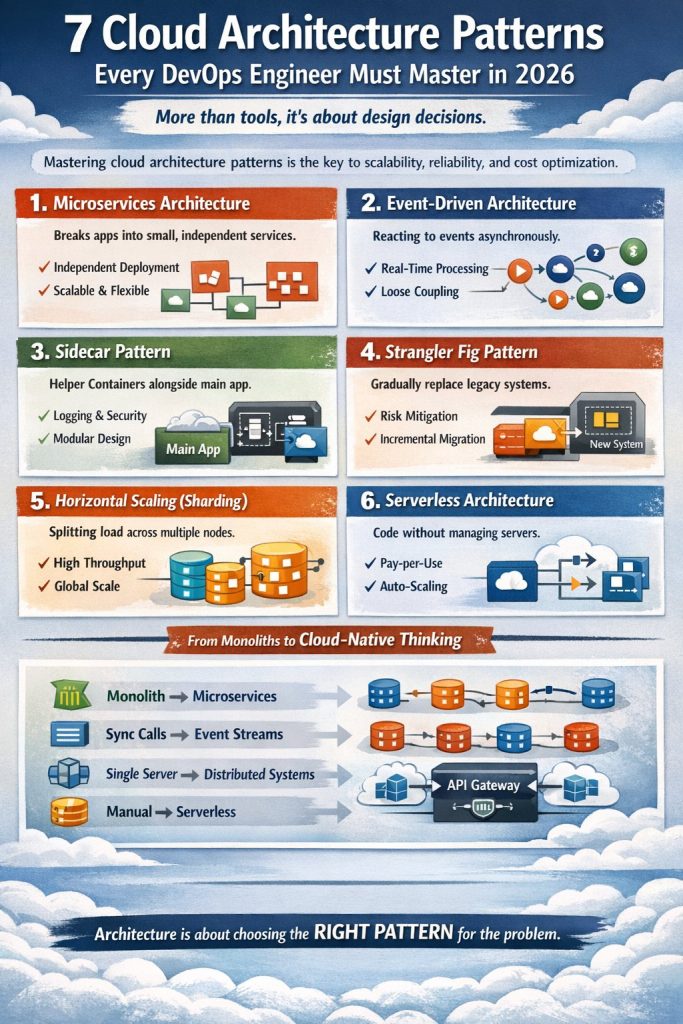
Let’s break down 7 Cloud Architecture Patterns you must deeply understand 👇
1) Microservices Architecture
Microservices architecture breaks a large application into small, independent services that communicate over APIs.
Each service:
- Owns a specific business capability
- Has its own deployment lifecycle
- Can scale independently
- Can use different technologies if needed
This approach gained massive traction through companies like Netflix and Amazon, who needed extreme scalability and team autonomy.
Why It Matters
In monoliths:
- A small change requires full redeployment.
- Scaling one feature means scaling everything.
- Teams step on each other’s toes.
In microservices:
- Teams move independently.
- Failures are isolated.
- Scaling is precise and cost-efficient.
When to Use It
- Large, growing applications
- Multiple development teams
- High scalability requirements
- Continuous delivery environments
When Not to Use It
- Early-stage startups with small teams
- Simple CRUD applications
- When operational maturity is low
Microservices add complexity. You must earn the right to use them.
2) Event-Driven Architecture (EDA)
Event-driven architecture is built around events — state changes that trigger reactions.
Instead of:
Service A calls Service B synchronously
You design:
Service A emits an event
Service B reacts when ready
Platforms like Apache Kafka made this pattern mainstream for real-time systems.
Why It Matters
EDA provides:
- Loose coupling
- High scalability
- Real-time responsiveness
- Better fault tolerance
If one service fails, others can continue processing events.
Ideal Use Cases
- Real-time analytics
- Payment systems
- E-commerce order pipelines
- IoT systems
- Notification systems
Architectural Impact
You move from request-response thinking to event-stream thinking.
This shift changes how you:
- Debug systems
- Ensure data consistency
- Monitor flows
- Design resilience
EDA is powerful — but requires strong observability and data governance.
3) Sidecar Pattern
The Sidecar pattern adds a helper container alongside your main application container.
Instead of building logging, monitoring, or networking into your app…
You attach a companion container that handles those concerns.
This pattern is widely adopted in Kubernetes ecosystems.
For example:
- Service mesh proxies
- Logging agents
- Security proxies
Service meshes like Istio rely heavily on sidecars.
Why It Matters
It separates:
- Business logic
- Infrastructure concerns
Your application stays clean.
Cross-cutting concerns stay external.
Best For
- Kubernetes environments
- Zero-trust networking
- Observability-heavy systems
- Large microservices platforms
This pattern increases modularity and operational control.
4) Strangler Fig Pattern
Modernizing legacy systems is risky.
The Strangler Fig pattern solves this by gradually replacing parts of a legacy system piece by piece.
Instead of rewriting everything:
- Route specific functionality to a new service.
- Slowly expand new system coverage.
- Eventually remove the legacy system.
The name comes from how a strangler fig tree grows around a host tree and eventually replaces it.
Why It Matters
Full rewrites often:
- Fail
- Overrun budgets
- Disrupt customers
Strangler pattern:
- Minimizes risk
- Allows incremental validation
- Maintains business continuity
Ideal Use Case
- Legacy monolith modernization
- Enterprise digital transformation
- Cloud migration journeys
If you’re working with large enterprises in 2026, this pattern is essential.
5) Horizontal Scaling
Horizontal scaling means adding more machines instead of increasing machine size.
Sharding specifically refers to splitting data across multiple databases or nodes.
Instead of:
- One giant database
You design:
- Multiple shards distributed by key (user ID, region, etc.)
Companies operating at global scale depend on this.
Why It Matters
Sharding:
- Improves throughput
- Reduces bottlenecks
- Enables global performance optimization
But it introduces:
- Data distribution complexity
- Rebalancing challenges
- Cross-shard query issues
Use It When
- Handling millions of users
- Processing massive data
- Running high-write workloads
Scaling vertically has limits. Horizontal scaling is the future of distributed systems.
6) Serverless Architecture
Serverless allows you to run code without managing servers.
You focus on:
- Business logic
- Not infrastructure
Cloud providers handle:
- Scaling
- Patching
- Provisioning
- Availability
For example, AWS Lambda enables event-driven execution at massive scale.
Why It Matters
Serverless provides:
- Zero idle cost (pay per execution)
- Automatic scaling
- Faster time to market
- Reduced operational overhead
Ideal For
- Unpredictable workloads
- APIs
- Background jobs
- Prototypes
- Event-driven systems
Trade-Offs
- Cold starts
- Vendor lock-in
- Observability challenges
- Limited execution time
Serverless is powerful — but not universal.
7) API Gateway Pattern
An API Gateway acts as a single entry point for client requests.
Instead of clients calling multiple services directly:
They call the gateway.
The gateway handles:
- Routing
- Authentication
- Rate limiting
- Request transformation
- Logging
Tools like Kong and cloud-native gateways dominate this space.
Why It Matters
Without an API gateway:
- Clients become tightly coupled
- Security is inconsistent
- Monitoring is fragmented
With a gateway:
- Security centralizes
- Traffic control improves
- Services stay hidden internally
In distributed systems, API gateways are foundational.
From Monoliths to Distributed Thinking
Architecture evolution looks like this:
- From monoliths → to microservices
- From synchronous calls → to event streams
- From single servers → to distributed clusters
- From manual scaling → to auto-scaling
- From infrastructure-heavy → to serverless
But here’s the key insight:
These patterns are not trends.
They are tools in your design toolbox.
The Real Skill: Pattern Selection
A senior Cloud Engineer doesn’t ask:
"How do I use Kubernetes here?”
They ask:
- What are the availability requirements?
- What’s the expected traffic growth?
- What’s the failure tolerance?
- What’s the team maturity level?
- What’s the cost constraint?
Then they choose the right pattern.
Sometimes the correct architecture is:
A simple monolith behind a load balancer.
Overengineering is just as dangerous as underengineering.
Final Thoughts
In 2026, Cloud / DevOps engineers will be judged less on:
- Tool familiarity
- Certifications
- Number of technologies listed
And more on:
- Architecture decisions
- Trade-off awareness
- System thinking
- Business alignment
Next Steps :
Follow our DevOps tutorials
Explore more DevOps engineer career guides
Subscribe to InsightClouds for weekly updates
Devops tutorial :https://www.youtube.com/embed/6pdCcXEh-kw?si=c-aaCzvTeD2mH3Gv
Leave a Reply